Last week, I gave a talk at De Montfort University to launch their new Attributes Community of Practice. My talk, “Working with Graduate Attributes in a Living Curriculum,” explored attributes, their challenges, and how we can use them well. I won’t rehearse the whole talk, but here are a few key points, particularly around the challenges. I’m afraid this piece may generate more questions than answers!
Lots of words come to mind when we think of attributes: generic, skills, soft skills, employability, tick‑box, hidden skills, CV‑building qualities and more. Helpfully, Wong et al. (2022) undertook an analysis of exactly which attributes are in place across UK higher education. They identify four meta‑themes or groupings of attributes:
- Self‑awareness and lifelong learning
- Employability and professional development
- Global citizenship
- Academic and research literacy
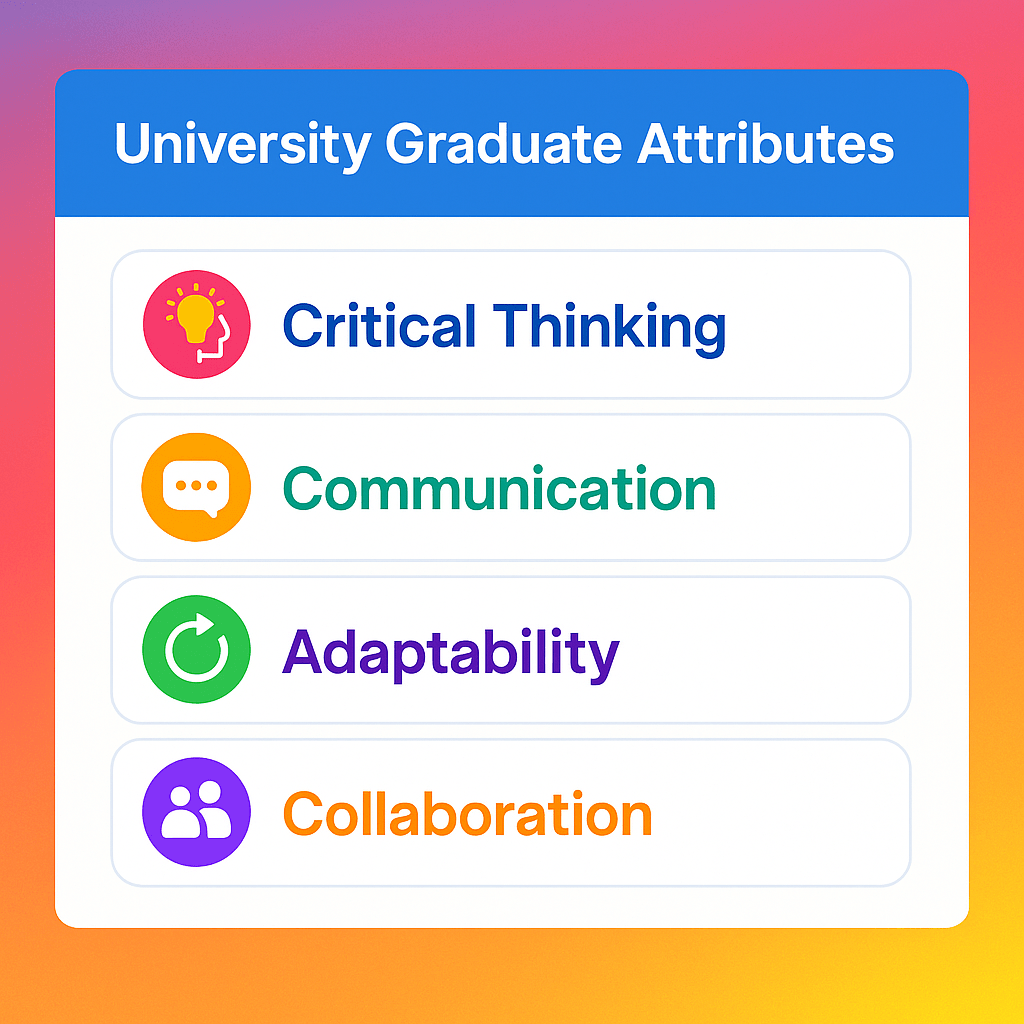
The colourful and graphical portrayal of attributes to make them memorable is not unusual. These ones are fictional, but are typical of what I have seen.
Despite more modern definitions, a fulsome definition from 2000 still holds up well, and I appreciate its emphasis on the whole student’s future rather than only on employability:
“Graduate attributes are the qualities, skills and understandings a university community agrees its students should develop during their time with the institution. These attributes include, but go beyond, the disciplinary expertise or technical knowledge that has traditionally formed the core of most university courses. They are qualities that also prepare graduates as agents for social good in an unknown future.” Bowden (2000)
That “unknown future” demands we keep looking up and out to see what students need by way of attributes. These shouldn’t be static definitions. Yes, we could include digital skills -and we may even have done so in 1999 – but the detail of those skills today is clearly different. Staying alert to new technologies, challenges, solutions, emerging values, geographies and politics matters. We cannot sit still with attributes; they need to be interpreted and reinterpreted. They should live in our curriculum.
It also strikes me that attributes are not neutral. Published attributes can reflect an institution’s priorities and culture – and they’re not challenge‑free. How do we embed them? How do we assess them (if at all)? How do we prioritise them? Here are some questions I raised to seed thinking:
- Ownership and investment: Faculty all have an interest, but students must invest in and own their development. How do we facilitate that ownership?
- Familiarity leading to a loss of meaning: Familiar, branded attribute models can become shorthand. Do we really know what we’re trying to develop in students? Can we still articulate what we mean by our own attributes?
- Staff capability: If we asked faculty to demonstrate these skills themselves, how would they perform? Are staff able to facilitate attributes at the right level?
- Coordination complexity: We risk some attributes being well covered while others remain invisible. Can we join up our planning so nothing is left to chance? (and does it matter is some are missed, or if students engage with the attributes in different ways?)
- Build for diversity: ‘Organised’ in a student with ADHD may look very different from ‘organised’ in a neurotypical student. How do we ensure attributes are appropriate for different learners, guarding against ableism and exclusion?
- Extracurricular reliance: Extracurricular activities can develop attributes (Foley et al., 2023), but how reliant are we on them? What does that mean for inclusion?
- Curriculum crowding: Instead of asking “How do we make room for attributes?”, perhaps we should design them as core to our programmes. How do we ensure the time and space needed for attribute development?
- Mapping fatigue: With institutional requirements and professional‑body standards, mapping can get complex. What value does mapping add – embedding attributes in practice, or merely on paper?
- Contested values: Attributes reflect institutional values. Whose values are we conveying and reproducing? (and are we comfortable with this!?).
Critical consideration of attributes seems important, which is why it is so good to see events such as this to bring them in to focus. I personally had lots of questions about assessment: Should we set criteria and benchmark standards? Use ipsative assessment to track individual growth? Or avoid assessing attributes altogether, to keep our already‑crowded assessment space manageable and to reflect and respect the ipsative journey of individuals? Whatever we choose, institutions need to be clear about how their attributes sit within curriculum, asking what are they doing? This need for a critical view is also important in the employability space: So many attributes revolve around employability, yet however important these are, we also need to remember that employment is not (and in my view should bever be) the sole aim of university. It’s important, of course, but higher education is more than that. Attributes shouldn’t be code for ‘tick list for employment’.
I briefly presented different practical ways of embedding attributes, including placement and work opportunities, building an attributes-led curriculum, programme-level planning, faculty development, community events, extra-curricular in curriculum, attribute awards, volunteering and community, and developing a shared language. We perhaps raised more questions that one afternoon could answer but it was good to have space to deep dive on this topic. The research by Wong et al. highlighted the lack of research around attributes, which is something I observed as I pulled this session together. More work is needed but for now my takeaway is that attributes shouldn’t be a footnote, checklist or even just a funky graphic, they should be active, living, social, and evolving, and they should be regularly discussed and critiqued.
Slides are available on request.
Bowden, J., Hart, G., King, B., Trigwell, K., & Watts, O. (2000). Generic capabilities of ATN University graduates. Australian Government Department of Education, Training and Youth Affairs.
Foley, Carmel, Simon Darcy, Anja Hergesell, Barbara Almond, Matthew McDonald, Lan Thi Nguyen, and Elizabeth Morgan-Brett. 2023. ‘Extracurricular Activities, Graduate Attributes and Serious Leisure: Competitive Sport versus Social-Cultural Clubs in Campus Life’. Leisure Studies 42 (6): 971–88. https://doi.org/10.1080/02614367.2023.2168030.
Wong, Billy, Yuan-Li Tiffany Chiu, Meggie Copsey-Blake, and Myrto Nikolopoulou. 2022. ‘A Mapping of Graduate Attributes: What Can We Expect from UK University Students?’ Higher Education Research & Development 41 (4): 1340–55. https://doi.org/10.1080/07294360.2021.1882405.



 Lydia Arnold
Leave a comment