Earlier last month I led a ‘training’ session on mentoring for colleagues at a local School Trust (as this is a personal rather than an institutional platform, I won’t name them here).
In preparation, I worked through ‘what makes a good mentor?’ and ‘what makes an effective mentoring system?’. The aim of our exchange was to share lessons between higher education and schools (back and forth). I shared experiences of mentoring colleagues undertaking professional development, including through Professional Standards Framework (PSF) Fellowship mentoring students on various programmes, and by observing others in action. Here are ‘six things’ that I prioritised for effective mentoring PSF, and I wonder if these points hold up in any mentoring situation?
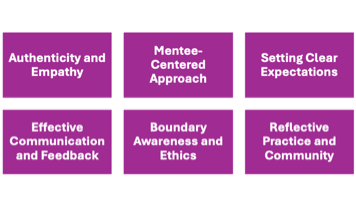
1. Authenticity and Empathy
Effective mentoring hinges on authenticity i.e. being you. Authentic mentors are transparent, self-aware, and emotionally present. This fosters trust and deepens the mentoring bond. As I say to new colleagues there are infinite ways to shine as an educator, and so too as a mentor. Bringing oneself to the role is the most sincere and important element. Effective mentors take many forms, from a more process-based approach – making sure all steps are followed – to someone working in a more freestyle form.
2. Mentee-Centred Approach
The best mentoring places the mentee at the centre. We therefore need ego-awareness. Mentors need to focus on the mentee’s goals, not their own narratives. In practice this means mentee-led agendas, listening well, and the active avoidance of leaping in with anecdotes and stories about your own experience – these have a place, and can be a way of connection but with a strong self-awareness and awareness of boundaries.
3. Setting Clear Expectations
Establishing clear, mutual expectations really matters. What is ‘in’ and what is ‘out’ of our relationship? That’s for each situation but leave no room for ambiguity since confusion in this area can lead to mentors being confronted by situations that they are underequipped to support. Knowing what the mentor’s role is not, allows support to be found elsewhere for other matters.
4. Effective Communication and Feedback
The mentor’s role as a skilled communicator is always important. Open-ended questions such as “How will you know you’re making progress?” or “What strengths could you use here?” can promote reflection and critical thinking. Good questions are more powerful than good answers in many cases. And, on feedback, consider particularly helping mentees to become feedback seekers and noticers themselves – support them to find, use, and evaluate feedback.
5. Boundary Awareness and Ethics
Critically, mentors must carefully manage boundaries, particularly to ensure the emotional burden of mentoring is sustainable. Also being clear on what happens in the event of guilty knowledge in a mentoring relationship – i.e. the mentor learning something of the mentee which is highly problematic or worse – dangerous or inappropriate. Boundary setting and clear expectations can help manage all of this but when dilemmas arise, mentors should know when to refer or seek external help.
6. Reflective Practice and Community
Mentoring is not a static skill, and it requires continued self-reflection, feedback, and growth. Encouraging mentors to model learning and join communities of practice can help. Helpful interventions include scheduled training sessions, digital groups (e.g. all the mentors working on x can share experiences), and even reading around relevant topics.
It was useful to have opportunity to share between settings and in our exchange the ‘same’ issues appeared to transcend school and university.
Based then, only on experience, here are six things to consider in metering. Others are scholars in this space, so please do seek other advice!



 Lydia Arnold
Leave a comment