

Whether for a promotion application, or a form of recognition such as Senior or Principal Fellowship, being able to tell your own story clearly really does matter. In my experience, in promotions and recognition, being able to incorporate the following elements into a claim can be very helpful. I need to be clear that I am talking generally here about teaching recognition, rather than about any scheme that I am actively involved in at the time of writing.
1. Narrative
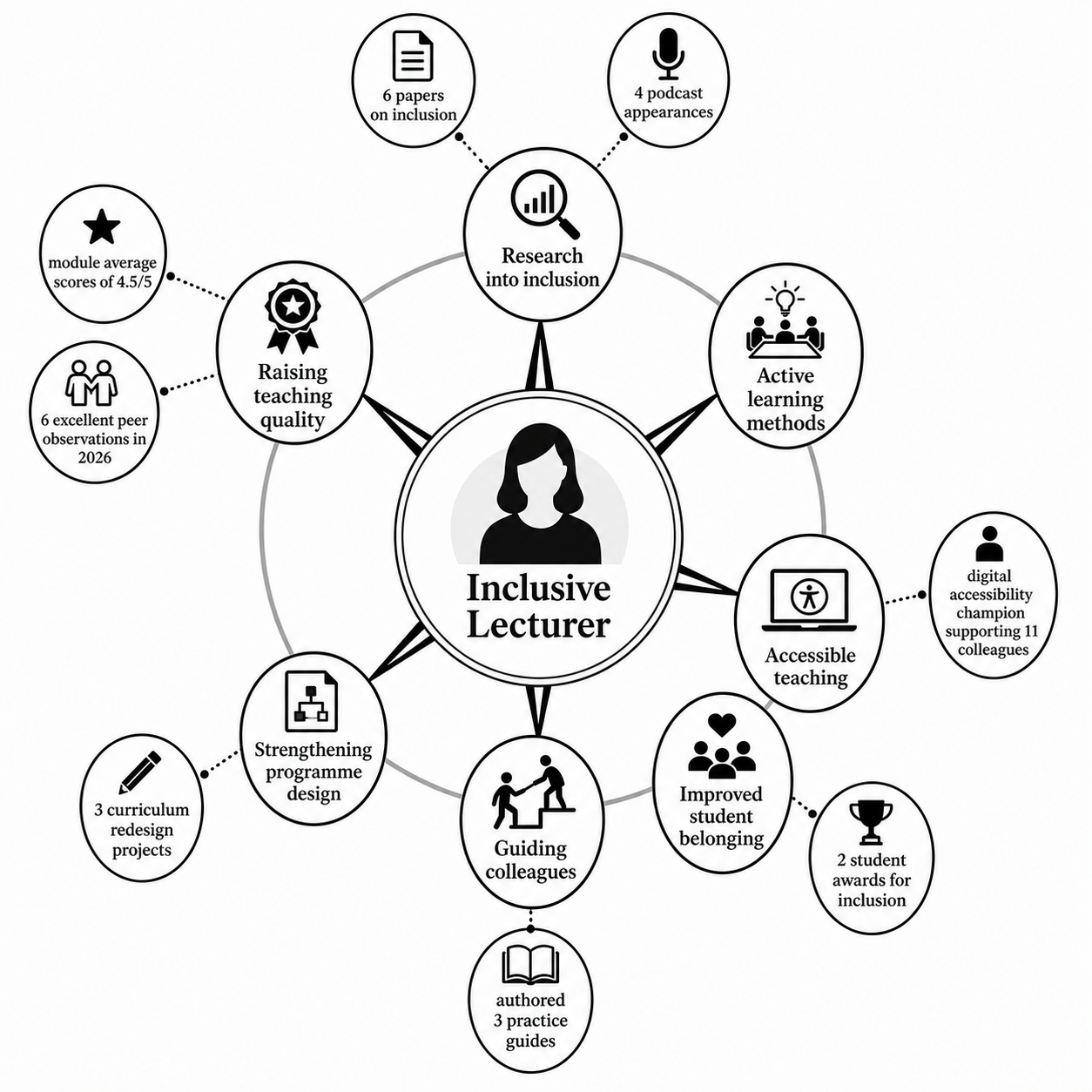
Who am I? What am I trying to do? What was my intention? What was I trying to build, and how did I set about it? Knowing your narrative, being able to define what sort of professional you are, is an important starting point for any claim. You need to be able to give this key information clearly rather than making assessors or panel members work it out. Rehearse the narrative; write, or even draw or diagram it. One of the strengths of universities is that everyone’s different, as some colleagues have a more industry or professionally oriented profile; others are more research-focused. The balance and flavour of activity varies widely, and that’s a strength, but that difference means that the framing of your application matters greatly if people are to make sense of all that follows. If that all sounds a bit vague, here are a couple of examples. In them you can quickly see who each person is and what drives and connects their work. The first one is from my National Teaching Fellowship, and the second has been made as an example:
I am a developer – a change maker and a campaigner for enhancement, and beyond my role I advocate excellent practice in learning and teaching outside. I push boundaries and engender change. One external colleague summarised: “they have been a powerhouse in changing learning and teaching and has had an impact on many institutions.”
I am a history lecturer, and inclusion is my north star. I use research into student experiences to strengthen my practice and to guide the work of others. Alongside this I create active, engaging learning environments that widen participation and raise quality. My aim is to combine evidence, energy, and generosity to improve teaching for all.
2. Connectivity
Once you know your narrative, you need to show how it works. To do this, connect the different parts of your role:
- research to teaching
- teaching to knowledge exchange
- professional leadership to teaching
- and any other elements!
Draw the lines. Show how the elements connect so that you are coherent. Without this, we risk looking busy rather than purposeful. Whenever you present something in your case, be clear what it is adding and how it links to your narrative.
Connectivity also matters because influence depends on it: what are you connected into, and who is connected in your orbit. Knowing where your networks are, internally and externally, and how you work across them helps you get things done, not just for your own interests but for your organisation.
3. Influence
For me, there is no promotion or recognition without influence. You can do excellent work, but if it isn’t shared or used for the good, it won’t carry the weight it should. Think about your influence, and treat it in a scholarly way. Be curious about the impact you’ve had, and you might be pleasantly surprised. If you cannot locate impact, then you might see where you need to amplify your work. Importantly, think in terms of ripples of influence: not just what you did, but who took up your ideas and where it travelled next. Influence is rarely linear. It spreads through students, colleagues, practices, and systems. Intentional influence is stronger than accidental influence. Be clear who you are trying to influence, what you are trying to bring, and how that connects back to your narrative.
4. Evidence
To support all of this, you need evidence. Avoid vague claims. Make your case clear and defensible using both quantitative and qualitative evidence.
It’s easy to default to publication metrics, but in teaching and leadership, think more broadly:
- how many students have you influenced?
- how many colleagues?
- if colleagues have taken up your practice, how many students has that reached?
This is where the ripples of influence become visible. Show the reach and the depth of your work.
5. Strategy
Finally, be clear what comes next. What is your personal strategy and how will this fit with organisational strategy and personal growth? Promotion and awards, particularly, are not just recognition of what you have done; they can be a judgement about what you will do with the platform granted to you. Similarly, for any Fellowships, you might consider good standing: once awarded, how will you move forward to embody the values and advance practice? Promotion, awards, and recognition are inevitably reflective, but confidence in what comes next makes an application feel complete and sincere.
So here is my recognition acronym, and even if you don’t write in these ways, as homework this will make applications stronger:
Narrative. Who you are.
Influence. What changes because of your work.
Connectivity. How your work fits together and across systems.
Evidence. How you make your case irrefutable.
Strategy. What you will do next, and how you will use the platform promotion gives you.
AI use? Yes for final polishing and making the graphic based on one that I already created.

Leave a Reply